

What is Gynecomastia?
Gynecomastia is the medical term for enlargement of glandular breast tissue in males. It’s one of the most common conditions affecting the male chest, and it can appear at almost any age, from the first weeks of life through the seventies and beyond.
It’s worth separating gynecomastia from pseudogynecomastia, which looks similar but has a different cause: pseudogynecomastia is chest enlargement from excess fatty tissue, not glandular growth. The distinction matters because it affects how the condition is evaluated and treated true gynecomastia involves actual breast gland development, while pseudogynecomastia is really a fat-distribution issue.
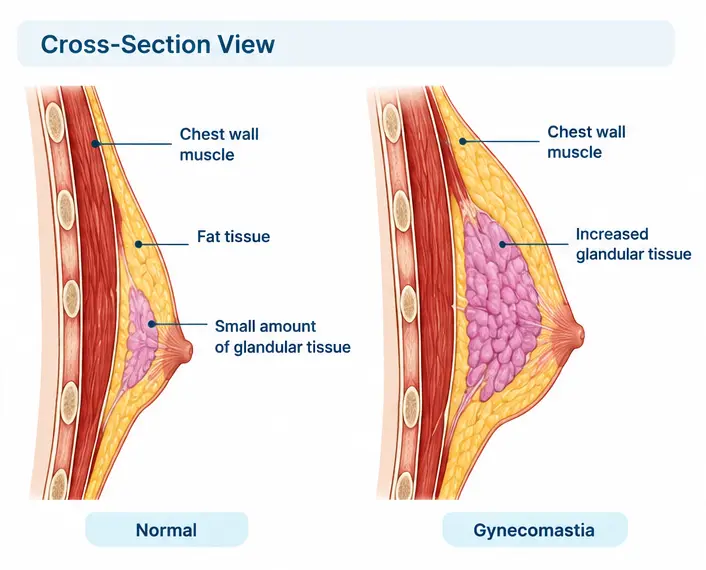
Gynecomastia can affect one breast (unilateral) or both (bilateral), and when both sides are involved, it’s common for the enlargement to be uneven, with one side larger than the other. At its core, the condition develops when the usual balance between testosterone and oestrogen shifts. Males naturally produce oestrogen in small amounts alongside much higher testosterone levels, and breast tissue is sensitive to that balance. When oestrogen’s relative effect increases, whatever the underlying reason, breast gland tissue can respond by growing.
Gynecomastia Across Different Life Stages
Newborns. Many baby boys are born with slightly enlarged breast tissue because of hormone exposure from the mother during pregnancy. This is temporary and typically resolves on its own within the first few weeks of life, without any treatment.
Adolescence. Pubertal gynecomastia is extremely common, driven by the hormonal swings that come with puberty. For most teenagers, it settles down within months to a couple of years as hormone levels stabilise.
Adulthood and older age. Later in life, gynecomastia is more often linked to natural declines in testosterone with age, certain medications, or an underlying health condition, which is why new gynecomastia in an older adult is more likely to prompt a doctor to look for a specific cause.
What Causes Gynecomastia?
There’s rarely a single, isolated cause; gynecomastia is usually the visible result of a shift in hormonal balance, and that shift can come from several directions at once.
1. Hormonal changes
The central mechanism is a change in the ratio of testosterone to oestrogen. Conditions that interfere with normal hormone production or how hormones act on tissue, including hypogonadism (low testosterone) and other endocrine disorders, can tip that balance toward breast tissue growth.
2. Puberty and ageing
Both ends of the age spectrum bring natural hormonal fluctuations. Puberty involves a surge and rebalancing of sex hormones, and ageing brings a gradual decline in testosterone, both of which can allow oestrogen’s effects on breast tissue to become more pronounced.
3. Certain medicines
Many medication classes have been linked to gynecomastia, including:
- Anti-androgen medicines (often used for prostate conditions)
- Some cardiovascular medications
- Certain drugs used for gastrointestinal conditions
- Some psychiatric medications
- Certain anti-infective medicines
- Anabolic steroids and other hormone-related substances
Being on a list like this doesn’t mean a medicine will cause gynecomastia in every person who takes it; individual response varies widely. If you suspect a medication is responsible, don’t stop it on your own; talk to the prescribing clinician first, since abruptly stopping some medicines can carry its own risks.
4. Underlying medical conditions
Because so many organs play a role in hormone production and clearance, disease in several different systems can contribute to gynecomastia, including conditions affecting the:
- Liver
- Kidneys
- Thyroid
- Testes
- Pituitary gland or other hormone-producing tissue
Liver disease, kidney disease, an overactive thyroid (hyperthyroidism), and hypogonadism can each alter circulating hormone levels enough to trigger breast tissue changes.
5. Obesity
Excess body weight contributes in two overlapping ways. Fat tissue itself can convert other hormones into oestrogen, and in many people carrying extra weight, some of the chest enlargement is genuinely fatty tissue rather than glandular growth (pseudogynecomastia). Often both processes are happening together.
What are the symptoms of gynecomastia?
Symptoms differ from person to person, but the common signs include:
- Enlargement of breast tissue, on one or both sides
- A firm, rubbery area of tissue directly beneath the nipple
- Swelling around the nipple or areola
- Tenderness or sensitivity, especially early on
- Pain, particularly during the initial phase of tissue growth
- Increased nipple sensitivity
Beyond the physical symptoms, gynecomastia often carries a real emotional weight. Feeling self-conscious about chest appearance is common, and it can affect confidence around activities like swimming, sports, or simply changing clothes in a shared space, particularly for teenagers. That emotional impact is a legitimate part of the condition, not something to dismiss, and it’s a reasonable reason on its own to seek medical advice and discuss options.
Can gynecomastia cause breast cancer?
This is probably the single most common worry people bring to a doctor’s appointment about gynecomastia, and the reassuring answer is that gynecomastia itself is not cancer.
Gynecomastia is a benign enlargement of glandular tissue. It is not a tumour, and having it does not mean cancer is developing. But that reassurance comes with an important caveat: not every lump or area of enlargement in the male chest is gynecomastia, and male breast cancer, while uncommon, does exist.
Signs that warrant a closer look
1. A firm or hard lump, distinct from the softer, rubbery feel typical of gynecomastia
2. A new lump on only one side
3. Nipple discharge, especially if it’s bloody
4. Nipple inversion (turning inward)
5. Dimpling or puckering of the skin over the breast
6. Other visible skin changes
7. Swollen lymph nodes in the armpit
Is there a real association with male breast cancer?
Some observational research has reported an association between gynecomastia and male breast cancer, but that’s not the same as saying ordinary gynecomastia turns into cancer. A more accurate way to understand it: certain underlying conditions raise the risk of both gynecomastia and male breast cancer independently. Klinefelter syndrome is the clearest example it’s linked to both a higher likelihood of gynecomastia and an increased risk of male breast cancer.
Gynecomastia is a benign condition and is not itself breast cancer, but a new, unusual, or suspicious breast lump in a man should be evaluated to rule out other causes, including the rare possibility of breast cancer.
When should you see a doctor?
Most gynecomastia doesn’t need urgent attention, but certain features shift it from “probably normal” to “worth getting checked promptly.” Book an appointment if breast enlargement is:
- New or increasing quickly
- Firm or hard to the touch
- Located away from directly beneath the nipple
- Accompanied by nipple discharge or bleeding
- Accompanied by the nipple turning inward
- Accompanied by dimpling or other skin changes
- Accompanied by swollen lymph nodes
- Persistently or significantly painful
A doctor may also want to investigate further if gynecomastia appears suddenly in adulthood with no obvious trigger new medication, weight change, or known health condition- since that pattern makes an underlying cause more likely.
How is gynecomastia diagnosed?
Diagnosis usually starts with a conversation and a physical exam rather than jumping straight to imaging or lab work. Expect to be asked about:
- When the enlargement started and how it’s changed
- Whether one or both breasts are involved
- Any pain or tenderness
- Current medications and supplements
- Any use of anabolic steroids or performance-enhancing substances
- Existing medical conditions
- Any changes in sexual or reproductive health
- Family history of breast cancer
During the exam, a doctor will typically check the breast tissue itself, the nipples, nearby lymph nodes, and often the abdomen and genital area, since conditions affecting the liver or testes can be relevant contributors.
Tests that might follow
Not everyone needs every test; what’s ordered depends on age, symptoms, and what the exam suggests. Possible investigations include:
- Blood tests
- Hormone level testing
- Breast ultrasound
- Mammography
- Testicular ultrasound
- Other imaging as needed
- Biopsy, if clinically indicated
What’s involved in treating gynecomastia?
Treatment isn’t one-size-fits-all it depends on the cause, how long the tissue has been present, how severe it is, and whether it’s actually causing symptoms or distress.
1. Observation
For physiological gynecomastia, especially during puberty, doing nothing but monitoring is often the right call. As hormone levels settle, the tissue frequently regresses on its own.
2. Treating the underlying cause
When gynecomastia stems from an identifiable condition, addressing that condition can resolve the breast changes too. If a medication looks like the culprit, a clinician may consider switching or stopping it, but this should always be a conversation with the prescriber, never a decision made alone.
3. Medication
In selected cases, medicines such as selective oestrogen receptor modulators (tamoxifen is one example) may be considered. These tend to work better when the gynecomastia is relatively recent; tissue that has been present for a long time and has become more fibrous typically responds less well to medication alone.
4. Surgery
Surgery becomes an option when the enlargement persists, causes ongoing discomfort, or creates significant concern about appearance that hasn’t resolved with other approaches. Common approaches include:
- Liposuction removes excess fatty tissue, but doesn’t address glandular tissue directly.
- Mastectomy or glandular excision surgically removes the excess glandular tissue itself.
- Combined procedures combine liposuction and glandular excision together, for cases where both fat and glandular tissue are contributing.
Which approach fits best depends on how much tissue is present, what type it is, and the individual’s anatomy and goals all things a surgeon will assess directly.
Can gynecomastia go away on its own?
Yes, quite often. This is especially true for gynecomastia linked to infancy or puberty, where no treatment is usually needed at all. Pubertal gynecomastia commonly improves within roughly six months to two years.
That said, persistent gynecomastia in an adult shouldn’t automatically be written off as harmless, particularly if it appeared suddenly or comes with any of the warning signs covered earlier. “It’ll probably go away” is a reasonable starting assumption in a teenager it’s a less safe assumption in an adult with new, unexplained breast changes.
Frequently asked questions
Is gynecomastia the same as being overweight?
Not necessarily. Chest enlargement from excess fat alone is called pseudogynecomastia, and it’s different from true gynecomastia, which involves actual glandular tissue growth. The two can also occur together, since excess body fat can influence hormone levels that drive real glandular growth as well.
Will gynecomastia go away if I lose weight?
Weight loss can reduce the fatty component of chest enlargement, but it won’t shrink true glandular tissue on its own. If glandular tissue is the main driver, medical evaluation and, in some cases, surgery are the more effective routes.
Does gynecomastia mean my testosterone is low?
It can be a sign of that, but it isn’t the only possible explanation. Gynecomastia reflects the balance between testosterone and oestrogen rather than testosterone levels alone, and that balance can be affected by medications, liver or kidney function, thyroid activity, and other factors, which is why hormone testing is often part of the workup.
Is gynecomastia surgery permanent?
Removing glandular tissue surgically is generally durable, since that tissue doesn’t grow back the way it originally developed. However, future weight gain or new hormonal changes can still affect chest appearance afterward, which is worth discussing with a surgeon beforehand.
Should I be worried if only one side is affected?
One-sided (unilateral) enlargement is common with gynecomastia and isn’t automatically a red flag. That said, a new lump on only one side — especially if it’s hard, doesn’t move easily, or sits away from the nipple is one of the features doctors take more seriously, so it’s worth getting checked rather than assumed.
Conclusion
Gynecomastia is common, and in the vast majority of cases, it’s a benign response to shifting hormone levels during infancy, puberty, ageing, or in reaction to a medication or health condition. It is not the same thing as male breast cancer, and most cases resolve without any intervention at all.
Still, a new or unusual lump in the male chest deserves attention rather than assumption. Male breast cancer is rare, but hard lumps, nipple discharge, nipple retraction, and skin changes are worth a doctor’s evaluation to rule it out. For gynecomastia that’s persistent or bothersome, options range from simply monitoring it to treating an underlying cause to medication or surgery, and a healthcare professional is the right person to help decide which path fits your situation.
Medical disclaimer
|
References
- Mayo Clinic. Enlarged breasts in men (gynecomastia): Symptoms and causes.
- Mayo Clinic. Enlarged breasts in men (gynecomastia): Diagnosis and treatment.
- Merck Manual Professional Edition. Gynecomastia. Updated February 2025.
- American Cancer Society. Breast Cancer in Men.
- American Cancer Society. Causes, Risk Factors, and Prevention of Breast Cancer in Men.
- Faridi A, Gerber B, Hartmann S. Diseases of the Male Breast: Gynecomastia and Breast Cancer. Deutsches Ärzteblatt International. 2025;122(15):406–411.
- Brinton LA, et al. Anthropometric and hormonal risk factors for male breast cancer: male breast cancer pooling project results.