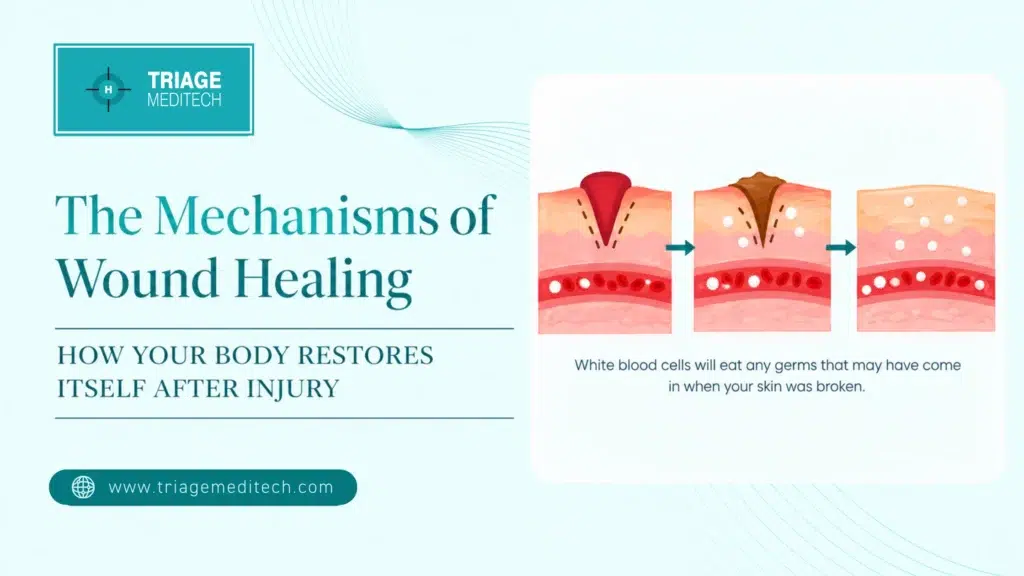
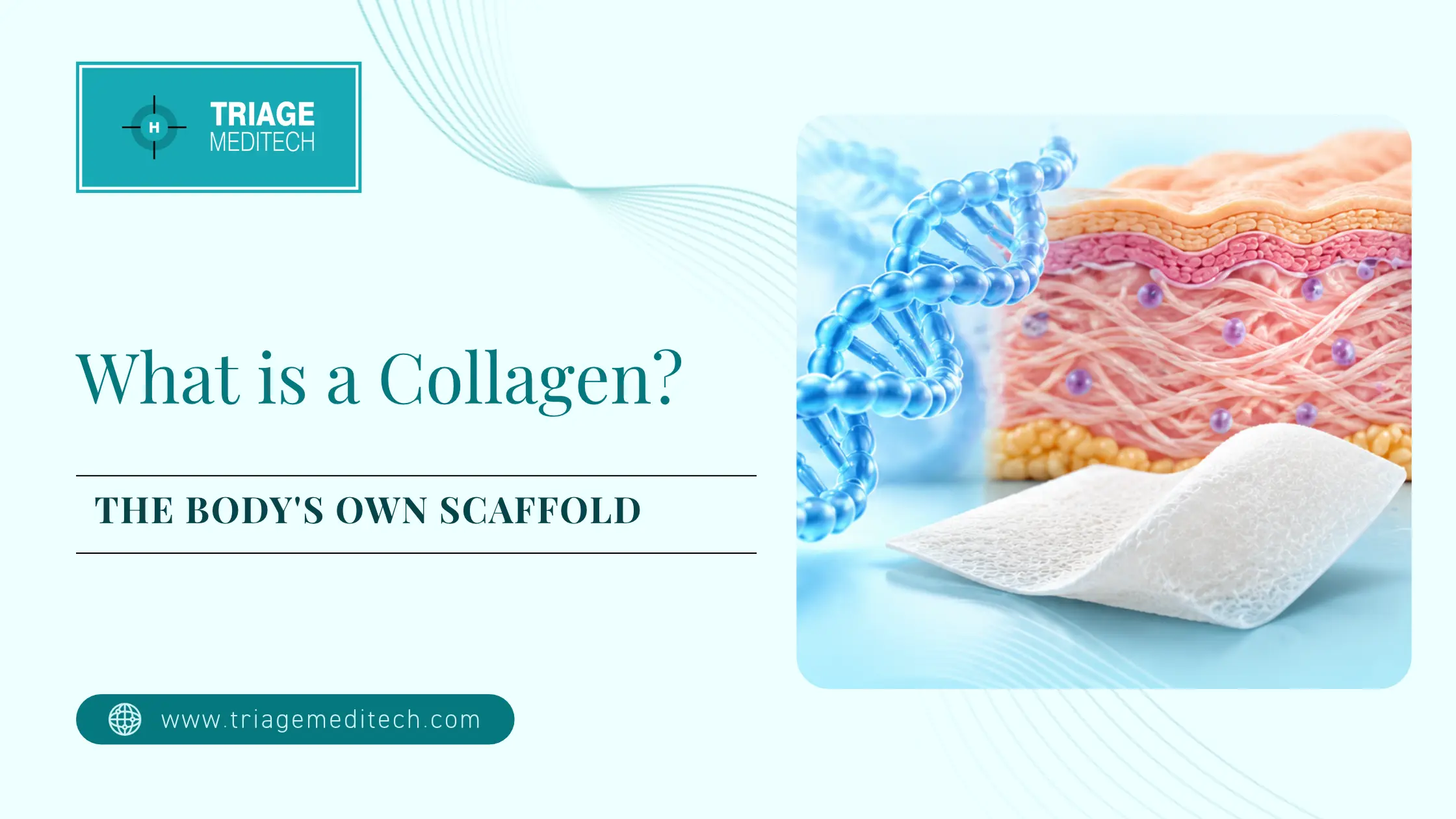
If you have ever watched a cut close over a week or two, you have watched collagen at work. It is the protein that gives skin its strength, and it is also the scaffold your body builds, breaks down, and rebuilds every time it repairs itself. When healing goes wrong, as it does in diabetic foot ulcers, venous leg ulcers, and pressure injuries, doctors and wound-care teams increasingly turn to that same protein as a treatment. This article explains what collagen is, why it matters at every stage of healing, how collagen dressings are made, and what to ask before choosing one.
KEY TAKEAWAYS
|
What is Collagen?
Collagen is the most abundant protein in the body. It makes up roughly a quarter of all human protein, and in skin it accounts for about 70 to 80 per cent of the dry weight [1][2]. Think of it as the steel reinforcement inside concrete: it gives tissue tensile strength so skin can stretch without tearing.
At the molecular level, collagen is built from three protein chains wound together into a stiff, rope-like triple helix. Those ropes then assemble into fibres and networks that fill the space between cells, known as the extracellular matrix. Researchers have identified 28 types of collagens. Type I is the workhorse, around 90 per cent of the body’s collagen and the form most used in dressings and research, while type III is the flexible, early forming collagen that appears first in repairing tissue [2].
Why Collagen Matters at Every Stage of Healing
A normal wound heals in four overlapping phases. Collagen takes part in all of them, both as the physical scaffold and as a chemical signal [2][3].
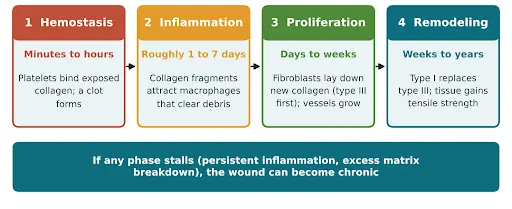
- Hemostasis (minutes to hours). When a vessel is cut, platelets bind to exposed collagen. That contact helps trigger clotting and releases growth factors that start the repair.
- Inflammation (about 1 to 7 days). Fragments of collagen attract macrophages, the clean-up cells that remove debris and bacteria. This is a necessary step, but it must end on time.
- Proliferation (days to weeks). Fibroblasts move in and build new collagen, mostly type III at first. Collagen fragments also act as signals that encourage new blood vessels and help skin cells migrate across the wound surface.
- Remodeling (weeks to years). Type III is gradually replaced by stronger type I, and the scar matures. Full recovery of strength can take months to years.
Because collagen is involved so deeply, anything that disrupts it can stall the whole process. That is exactly what happens in a chronic wound.
Why Some Wounds Stall, and How Collagen Dressings Help
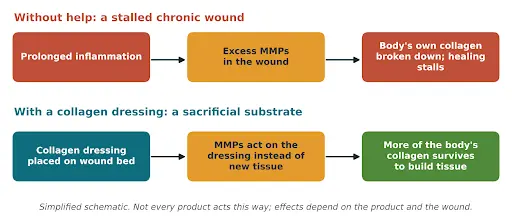
In a chronic, non-healing wound, the usual story is persistent inflammation. The wound stays in the inflammatory phase, and the surrounding fluid fills with high levels of enzymes called matrix metalloproteinases (MMPs). In small amounts, MMPs are helpful because they clear damaged tissue. In excess, they chew through the collagen and growth factors the wound is trying to use to rebuild [3][1].
This is where collagen dressings come in. The leading explanation is that a dressing made of collagen acts as a sacrificial substrate: the excess MMPs attack the dressing instead of the patient’s own new tissue. Reviews also describe collagen breakdown products as chemical signals that draw in cells needed to form granulation tissue and note that these dressings absorb exudate and help keep the wound bed moist [1].
Native Collagen Versus Gelatin
There is a subtle point that makes a difference when comparing products. Native type I collagen mainly attracts an enzyme called MMP-1, while denatured collagen (gelatin) attracts MMP-2 and MMP-9, which are the ones commonly elevated in chronic wounds. Gelatin also exposes cell-attachment sites that help cells grip the surface. Some dressings therefore use partially denatured collagen on purpose [1]. If a product brochure talks about “native” versus “denatured” collagen, this is why.
Where does the Collagen come from?
Collagen for medical products is not made in a flask from scratch in most cases. It is extracted and purified from animal tissue or increasingly produced by recombinant technology. Each route has trade-offs [2].
| Source | Strengths | Things to consider |
|---|---|---|
| Bovine (cow) | The main industrial source, from skin, bone, and tendon. Good biocompatibility and low immunogenicity. | Batch consistency varies with the animal’s age and origin. Disease-transmission concerns (BSE/TSE) drive interest in alternatives. Rare allergic reactions are reported. |
| Porcine (pig) | Another common type I source with a long history of use. | Not acceptable to some patients on religious or cultural grounds, so discuss with the patient. |
| Marine (fish and others) | Lower disease-transmission risk and no religious prohibitions. Can use fish-processing by-products. | Lower melting point and lower water solubility, so physical handling and stability need engineering. |
| Recombinant human | Animal-free, uniform quality and traceable, which lowers infection and species-cross risk. | Regulators assess it differently from native collagen, and standard testing methods are still being developed. |
Pure collagen on its own breaks down quickly in the body and can be mechanically weak. Manufacturers therefore stabilise it by crosslinking (using chemical agents, or physical methods such as heat treatment under vacuum) or by combining it with other materials such as alginates, cellulose derivatives or chitosan. That is why two “collagen” dressings can behave very differently on the same wound [2][1].
Forms of Collagen Dressings
Collagen reaches the wound in several formats. The right one depends on how wet the wound is, how deep it is, and whether it is infected [1][2].
| Format | What it is | Typical use and handling |
|---|---|---|
| Sponge/pad | A porous, highly absorbent collagen matrix with good air and vapour permeability. | Moderately to heavily exuding wounds. Changing intervals ranges from daily to weekly depending on how saturated it becomes. |
| Film/sheet | A thin collagen layer, often around 0.1 to 0.5 mm. | Shallow wounds and donor sites. Can be hard to handle once wet. |
| Hydrogel | Collagen is held in a water-rich gel (about 70 to 90 per cent water). | Dry or low-exudate wounds that need moisture. Changed every 1 to 3 days in the studies reviewed. |
| Powder/particles/gel | Collagen in a flowable form that conforms to uneven wound beds. | Irregular or deeper wounds. Usually needs a secondary dressing. |
| Nanofibre scaffolds | Electrospun collagen fibres that mimic natural matrix architecture. | Mostly at the research stage, with promising lab and animal results. |
Practical point: collagen dressings usually need a secondary dressing to hold them in place and manage exudate. Change frequency, wound suitability, and contraindications always come from the manufacturer’s instructions for use (IFU) and the treating clinician, not from a general article like this one.
Who Might Benefit, and Where to Be Careful
Collagen dressings are generally considered for wounds that are not progressing despite good basic care, for example, diabetic foot ulcers, venous leg ulcers, pressure injuries, and some partial-thickness wounds and donor sites. The reason is straightforward: these are the wounds in which matrix breakdown and stalled inflammation are most common.
Honest Limits of the Evidence and the Product
- Much of the newest work is early. The recent format studies in nanofibres, hydrogels and films cited in the 2025 review are mostly cell-culture and animal experiments, not large human trials [2]. Always check recent systematic reviews and the manufacturer’s clinical data before making strong claims.
- Allergy and source concerns. Rare severe reactions to bovine collagen have been reported, and patients may have cultural or religious preferences about animal sources [2].
- Handling. Some films lose handling strength when wet, and collagen-only matrices can degrade quickly if not crosslinked [2].
- A dressing cannot fix the underlying cause. Infection, poor blood supply, pressure, uncontrolled diabetes, and poor nutrition must still be treated.
- Follow the IFU. Typical labels list situations where a product should not be used, such as known allergies to the source animal or certain wound types. Always read the label.
Collagen in the wider wound-care toolkit
Modern wound care rarely relies on one product. A hospital team typically combines several tools: negative pressure wound therapy (NPWT) to manage open wounds, post-operative dressings to protect surgical incisions, absorbent foam and antimicrobial dressings to control exudate and bioburden, and regenerative or matrix-based products to support tissue repair when wounds are slow to progress.
Indian wound-care companies now cover much of this toolkit. Triage Meditech, a New Delhi-based company founded in 2013, lists on its website a portfolio that spans open-wound management (CYCLOTHERA, an NPWT system), incision management (INCICARE), advanced wound-care dressings (COMFISORB FLEXI and Dermacell) and a tissue-regeneration range (Permecoll, shown as “Coming Soon”) [4][5]. Understanding the biology of collagen helps clinicians and sales teams explain where a regeneration-oriented product fits alongside NPWT and advanced dressings: first control the wound environment, then support the tissue.
Seven Questions to Ask About Any Collagen Product
Whether you are a clinician, a procurement lead or a representative explaining a product, these questions separate a well-engineered dressing from a generic one.
- What is the source? Bovine, porcine, marine or recombinant, and what are the sterilisation and viral-safety controls?
- Which collagen type and form? Native type I, denatured gelatin, or a blend, and in what concentration?
- How is it stabilised? Crosslinking method or combined materials, since this determines how long it lasts in the wound.
- What format is it, and what secondary dressing is needed? Sponge, gel, powder or sheet, and how it is secured.
- What wounds is it indicated for, and what are the contraindications? Check the IFU line by line.
- What clinical evidence supports it? Look for published human data on the specific product, not just general collagen literature.
- What regulatory and quality approvals are in place? For India, that means appropriate CDSCO medical device registration, and for quality systems evidence such as ISO 13485.
Frequently Asked Questions
Q. Is collagen in a dressing the same as collagen supplements or skin creams?
Ans: No. A wound dressing is a regulated medical device applied to the wound bed and designed to be a scaffold or enzyme substrate. Supplements and cosmetics are different products with different purposes.
Q. Does collagen dressing make the wound heal faster?
Ans: It may help wounds that have stalled, mainly by protecting new tissue from excess MMPs and supporting cell activity. It is not guaranteed, and results depend on the wound and the overall care plan.
Q. Do I still need secondary dressing?
Ans: Usually yes. Many collagen dressings are held in place and covered by a secondary dressing, as the manufacturer’s instructions specify.
Q. How often has it changed?
Ans: It varies with the format and how much the wound drains, from daily to about weekly. Follow the product’s IFU and your clinician.
Q. Are there alternatives for patients who avoid animal products?
Ans: Marine-derived and recombinant human collagen are being developed for this reason, and other advanced dressings can be used. Ask the treating clinician.
The Bottom Line
Collagen is both the material your body uses to rebuild and a signal that tells healing cells what to do. In a stalled wound, a well-chosen collagen dressing can help rebalance the wound environment by absorbing the enzyme attack and supporting new tissue. The best results come when it is used as part of a complete plan, with the right source, format and instructions for the wound in front of you. As materials science improves, expect more stable, animal-free and combination products, and better human evidence to match.
| Disclaimer: This article is for general education and is not medical advice. Wound treatment decisions must be made by a qualified clinician, and product use must follow the manufacturer’s instructions. |
References
- Brett D. A review of collagen and collagen-based wound dressings. Wounds 2008. hmpgloballearningnetwork.com
- Collagen-Based Wound Dressings: Innovations, Mechanisms, and Clinical Applications. 2025. PMC12026876 (PubMed 40277707)
- Collagen in Wound Healing. PubMed 34064689
- Triage Meditech, product portfolio. triagemeditech.com
- Triage Meditech company listing, MTEC. mtec-sc.org